

Hidden journey: How buoyant microplastics sink deep into farmland soils
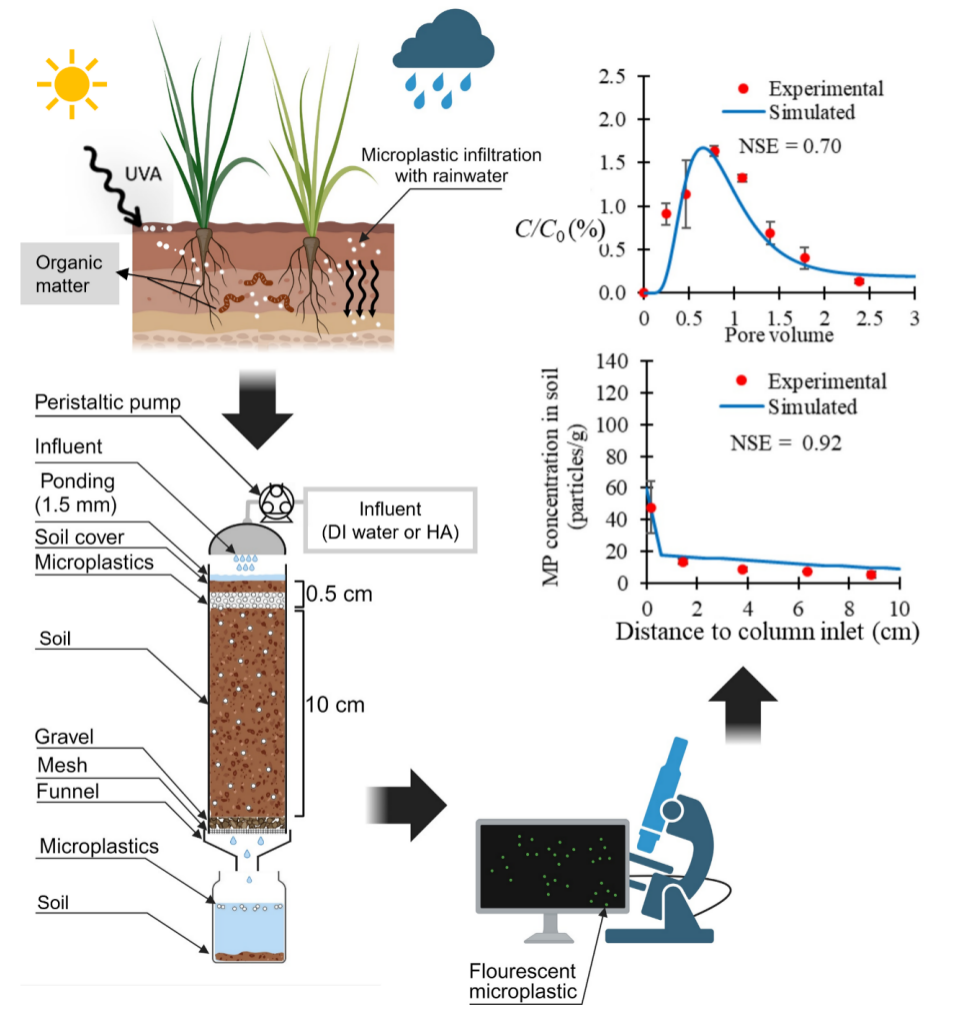
This graphical abstract summarizes the novel surface-spiked column experiment designed to simulate rainfall- or irrigation-driven migration of buoyant low-density polyethylene (LDPE) microplastics (10 ± 2 μm) through natural farmland soils.
GA, UNITED STATES, July 7, 2026 /EINPresswire.com/ -- Microplastics, long known to contaminate agricultural soils, were thought to mostly float away with surface water. New research challenges this assumption, revealing that buoyant microplastics can be significantly transported deep into the soil profile under conditions mimicking rainfall or irrigation. The study demonstrates that these particles, when initially resting on the soil surface, are not just a surface-level problem. They can be pulled down by infiltrating water, posing a substantial threat to groundwater quality and the broader soil ecosystem.
Agricultural lands are a major sink for microplastics, which originate from plastic mulches, biosolid fertilizers, and contaminated irrigation water. Previous laboratory studies have typically simulated this pollution by injecting microplastics directly into water that flows through soil columns. However, this approach fails to represent a more common, real-world scenario where microplastics are already present on the topsoil and are only mobilized by rainfall or irrigation. Most microplastics are also buoyant, leading to an assumption that they would remain near the surface or be carried away by runoff. Based on these challenges, there is a pressing need for in-depth research that mimics natural release conditions to accurately assess the true risk of microplastic infiltration into deeper soil layers and groundwater.
A new study published (DOI: 10.1007/s11783-026-2241-6) in 2026 in ENGINEERING Environment tackles this knowledge gap. Researchers from the University of Memphis, the University of Manchester, the University of Missouri, and Brown and Caldwell developed a novel experimental setup to track the movement of buoyant microplastics from the soil surface downward. Their work provides the first evidence that these particles can travel through natural soil under environmentally realistic flow conditions, fundamentally changing how we understand their fate.
The researchers designed an innovative "surface-spiked" column experiment. Instead of injecting plastics with water, they placed a layer of low-density polyethylene (LDPE) microplastics on top of soil columns and allowed water to infiltrate, simulating a natural rain or irrigation event. They tested two common agricultural soil types—silt and silt loam—and investigated the effect of natural organic matter (NOM) and ultraviolet (UV)-induced degradation on the particles. Results showed that a surprising amount of buoyant MPs penetrated the soil depth, with up to 1.4% of applied particles breaking through the column. The study revealed that soil texture is a critical factor: silt loam, which contains more clay, retained more MPs due to its smaller pores and greater surface area, while silt soil allowed for faster transport. Furthermore, the presence of humic acid (HA), a representative of NOM, significantly boosted the mobility of MPs by increasing repulsive forces between the particles and soil grains. UV-photodegraded MPs, which develop more oxygen-containing functional groups on their surface, also showed enhanced transport, traveling even deeper than their pristine counterparts.
"The common assumption has been that buoyant plastics simply float and are left behind on the surface," the authors said. "Our work shows that this is far from the full story. We've demonstrated that once they are trapped in the top layer of soil, infiltrating water can pull them down, and processes like attachment, detachment, and straining control their movement. The discovery that both natural organic matter and UV aging make them more mobile is particularly concerning, because it means that in a real-world environment, these contaminants could be migrating into our groundwater more readily than we previously thought."
This research has urgent implications for agricultural management and environmental risk assessment. It highlights that relying on the buoyancy of plastics as a natural barrier to soil contamination is a flawed strategy. Predictive models for soil and groundwater pollution must incorporate soil-specific factors like clay content and the presence of NOM. The findings also underscore the need to reconsider the long-term use of plastic mulches and the application of biosolids, as these practices introduce a continuous source of surface microplastics that can become a legacy contaminant in the subsurface. This study provides a crucial framework for developing more effective mitigation strategies to protect soil and water resources.
DOI
10.1007/s11783-026-2241-6
Original Source URL
https://doi.org/10.1007/s11783-026-2241-6
Funding Information
This study was supported by United States Department of Agriculture, National Institute of Food and Agriculture (USDA/NIFA) (No. 67019-31166-2020), U.S. National Science Foundation (No. 2340588), and Brown and Caldwell, USA.
Lucy Wang
BioDesign Research
email us here
Legal Disclaimer:
EIN Presswire provides this news content "as is" without warranty of any kind. We do not accept any responsibility or liability for the accuracy, content, images, videos, licenses, completeness, legality, or reliability of the information contained in this article. If you have any complaints or copyright issues related to this article, kindly contact the author above.
